Crime-associated inequality in geographical access to education: Insights from the municipality of Rio de Janeiro
Cities, 2025
View articleProfessor of Sociology
Instituto de Estudos Sociais e Políticos (IESP-UERJ) · Co-coordinator, CERES
I study income inequality, labor markets, and social stratification in Brazil. My work combines sociological theory with quantitative methods to understand the mechanisms behind persistent inequalities.
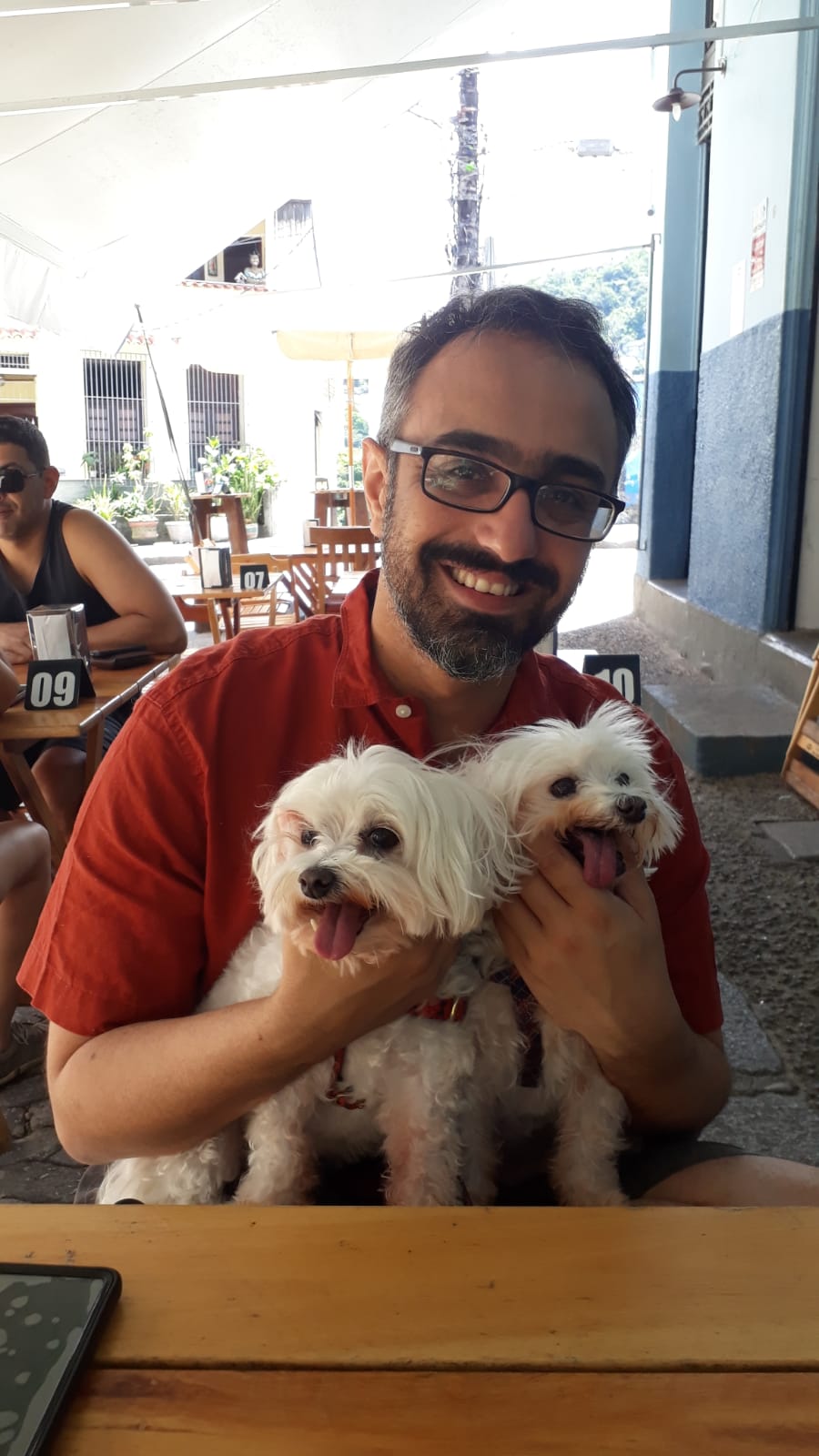
I am a Professor of Sociology at the Instituto de Estudos Sociais e Políticos (IESP) of the State University of Rio de Janeiro (UERJ). I hold a PhD in Sociology from the University of São Paulo (USP), where I also completed my Master's degree. I did my undergraduate studies in Social Sciences at the Federal University of Minas Gerais (UFMG).
I completed a postdoctoral fellowship in Political Science at USP, was a Visiting Scholar at the Department of Sociology at Columbia University, and an Affiliated Scholar at the Brazil Lab at Princeton University.
I co-coordinate the Centro para o Estudo da Riqueza e Estratificação Social (CERES-IESP/UERJ) with Carlos Antônio Costa Ribeiro, and I am an associated researcher at the Centro de Estudos da Metrópole (CEM-USP).
My research focuses on long-term trends in income inequality in Brazil, using historical surveys, administrative data, and contemporary microdata. I also develop open-source R packages for social research.
My research examines inequality, stratification, and labor markets through quantitative methods.
Long-term trends in earnings inequality in Brazil (1960-present), examining the roles of education, labor market institutions, and policy.
Intergenerational mobility, educational inequality, and the reproduction of social advantages across generations.
Employment dynamics, occupational structure, informality, and the impacts of economic crises on workers.
Survey methodology, causal inference, spatial analysis, and development of R packages for social research.
Impacts of armed group territorial control on educational outcomes in the Rio de Janeiro metropolitan area.
Cash transfer programs, emergency aid during COVID-19, and their effects on poverty and inequality.
CERES is the research hub I co-direct at IESP-UERJ, convening systematic work on stratification, mobility, inequality, wealth, poverty, and labor markets in Brazil. It hosts graduate seminars, produces the data infrastructure behind much of the research listed on this site, and is the institutional home of the Lego I–III methods sequence.
Studying citizenship practices and technologies around data production in the Global South, focusing on Brazil's 2022 census controversies.
Examining how territorial control by armed groups (drug trafficking and militias) constrains educational opportunities in Rio de Janeiro.
Full list available on Google Scholar (900+ citations, h-index: see profile).
Cities, 2025
View articleSociological Science, 2024
View articleRevista Brasileira de Ciências Sociais, 2023
View articleElectoral Studies, 2023
View articleBMJ Global Health, 2021
View articleThe Indian Journal of Labour Economics, 2020
View articleResearch in Social Stratification and Mobility, 2019
View articleDados - Revista de Ciências Sociais, 2016
View articleNovos Estudos CEBRAP, 2011
View articleIn: Metodologia de Pesquisa em Sociologia. UFSCar, 2024
In: Paths of Inequality in Brazil. Springer, 2018
In: São Paulo in the Twenty-First Century. Routledge, 2016
Public-facing applications for researchers, journalists, and policy analysts — no coding required.
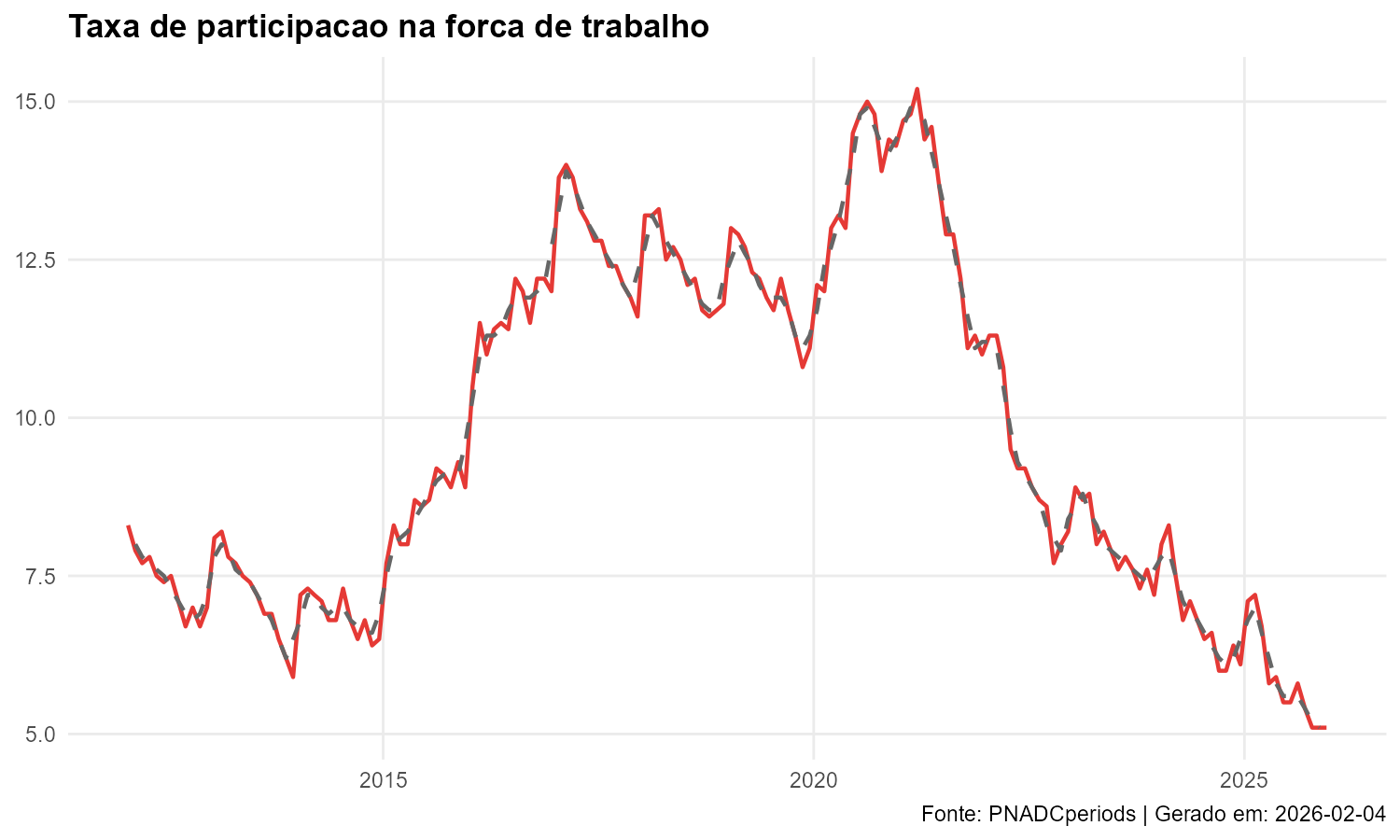
Explore 86+ monthly Brazilian labor-market series — unemployment, wages, informality — by state, sex, and age, with interactive charts and CSV export. Built on top of the PNADCperiods R package, so you do not need to know R to use it.
Local transcription of qualitative interviews in Brazilian Portuguese: Whisper/Parakeet ASR, speaker diarization, a built-in review studio, and on-device AI analysis (summaries, name glossary, semantic search). 100% offline, no cloud.
Open-source R packages for quantitative social research.
Convert Brazil's quarterly PNADC survey data into monthly, fortnightly, and weekly time series, and mensalize IBGE SIDRA aggregate series. Achieves ~97% monthly determination using IBGE's technical rules and birthday constraints, with calibrated survey weights. Includes an interactive dashboard for exploring 86+ official series.
Easy access to data from every Brazilian Population Census taken since 1960. Downloads and reads microdata, aggregate tables, and official documentation directly into R.
With Rafael H.M. Pereira (IPEA)
Estimation and inference for generalized Heckman selection models. Provides sandwich estimators, cluster-robust standard errors, and handling of eigenvalue issues in the variance-covariance matrix.
With Fernando S. B. Bastos (UFV) and Marcos O. Prates (UFMG)
Calculate inequality measures from categorical/tabulated data. Useful when only grouped data is available.
A three-term graduate sequence in quantitative methods (Lego I–II–III), plus substantive seminars on poverty, the life course, and sociological theory. Offered at the Graduate Programs in Sociology and Political Science of IESP-UERJ.
Introduction to quantitative analysis for the social sciences: statistical foundations, data preparation, descriptive analysis, and hypothesis testing in R.
With Carlos A. Costa Ribeiro · Fernando Meireles
Linear regression and its extensions (GLS, fixed effects, logistic, multilevel); diagnostics, robust inference, and applied workflows.
With Pedro H. G. Ferreira de Souza
Causal methods for observational, quasi-experimental, and experimental data: potential outcomes, difference-in-differences, instrumental variables, regression discontinuity, matching.
With Carlos A. Costa Ribeiro · Pedro H. G. Ferreira de Souza
How inequalities in earnings, education, and health accumulate and compound over individual lifetimes.
With Carlos A. Costa Ribeiro · Pedro H. G. Ferreira de Souza
Conceptual debates (absolute vs. relative, monetary vs. multidimensional), Brazilian measurement practice, and the political economy of poverty lines.
With Pedro H. G. Ferreira de Souza
Debates and methodological disputes in contemporary stratification and inequality research. Offered at IESP as Teoria Sociológica III – Controvérsias Desiguais.
With Carlos A. Costa Ribeiro
Programming fundamentals for social science research.
Automated data collection from the internet.
Concepts, methods, and data for contemporary Brazil.
I co-author Sociais & Métodos, a Portuguese-language blog on quantitative methods, R programming, and social science research methodology.
Instituto de Estudos Sociais e Políticos (IESP-UERJ)
Rua da Matriz, 82
Botafogo, Rio de Janeiro, RJ
22260-100, Brazil